

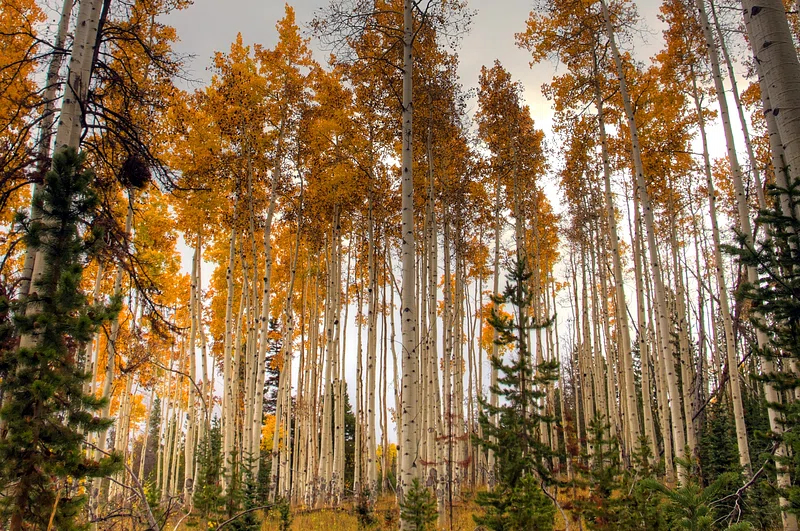
Many wonder what the largest living thing in the world is, people might think it would be an animal, or fungus, but in reality, it is a singular tree. Pando, also known as “The Trembling Giant,” because of how it shakes in the wind, is widely thought to be the largest living organism on the planet. The massive forest is a singular organism that works uniquely compared to other species of trees, and how a lack of local predators is slowly killing it.
Pando, which stands for ‘I spread’ in Latin, is the largest known organism on the planet. There are many other species of trees that clone themselves, but none have ever beaten Pando. According to Friends of Pando| How Pando Works, it is also known as the oldest living organism on the planet. It isn’t known for this because of its branches, but because of its ancient root system. The root system is thought to be anywhere from 9,000 to 16,000 years old, though some estimates place it at 80,000 years. It spans nearly 106 acres of land, which then consists of around 47 thousand stems. All of these stems are connected together through the root system, but there have been cases where patches of Pando farther out become disconnected from the main root system. This means that they become their own sort of Pando, and could help it survive if the main root system becomes damaged or destroyed.
Pando is a complex organism. It is not considered a single organism because of its branches, but because of its root system. The root system started from a seed many years ago, and shot up multiple different sprouts over time. All of these sprouts were connected to each other through their roots, though some may have broken off since then. These pieces that broke apart are still genetically identical to the main root system. The seed is suspected to have started growing around 9000 years ago, and that is when the growth of Pando began. The findings of it being a singular tree was done through genetic testing of different parts of the tree. According to Friends of Pando | How Pando Works NHMU, “Pando features over 40,000 ramets (aka stems, branches etc.) which look like individual tree trunks, but are in fact, parts of a single tree interconnected by a massive root system. Generally speaking, yes. Each of Pando’s branches is connected to the others through a shared root system. Yes. Pando’s roots build up and fan out. Sometimes, one outlying part of the tree can get isolated from the rest. Despite this, that section its still part of Pando. What’s more, it is possible that the newly isolated part of Pando can become the basis for a new structure of the larger tree. If all else were lost, that part could also continue Pando’s genetic line.” This shows that Pando consists of many different ramets, or sprouts, that are all connected through one large root system, and that sometimes pieces can be disconnected.
Sadly, Pando is dying. There are not multiple reasons that Pando is dying, but rather one main reason. Deer and elk populations in the area consume Pando’s stems before they can be sustainable enough to replace old and dying branches of the forest. Pando is not dying at a very quick rate, rather, it is not being able to maintain its water and sunlight needs. Historical management has caused many predators to be removed from the area. Causing the deer population to sharply rise. This rise in population has caused more stems to be eaten by the deer before they can grow, which means there aren’t any stems to replace the dying branches. Fencing has been put around parts of the forest to protect it from deer, but the impact from the fences are minimal. According to The Smithsonian Magazine, “In most areas of the grove, there are no ‘young or middle-aged trees at all,’ lead study author Paul Rogers, an ecologist at Utah State University, tells Yasemin Saplakoglu of Live Science. Pando, he adds, is made up almost entirely of ‘very elderly senior citizens.” This evidence, that comes from Smithsonian Magazine, shows that Pando is dying, though be it slowly, due to its stems being consumed before they can reach adulthood.
In conclusion, Pando is an humongous and amazing population of stems, which has a large root system that is complex, but is slowly dying. It has survived in its grove for over 9,000 years, and through multiple droughts. It deserves to be protected with what we can do.