
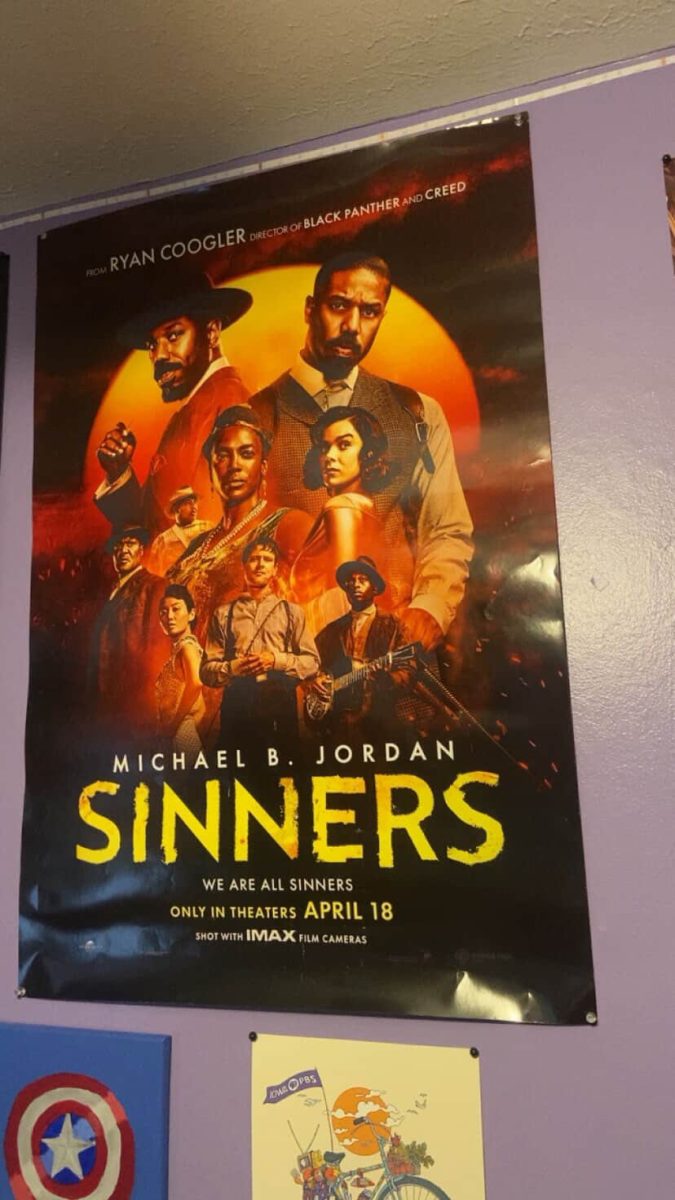
In an era where movies are constantly being created and released every day, a film occasionally emerges that isn’t just a source of entertainment but a beautiful display of the world’s cultural landscape. One of the movies that falls under this category is “Sinners”, a 4 Oscar-winning film directed by Ryan Coogler, starring Miles Canton and Michael B. Jordan. What makes Sinners different from other movies is its surreal, time-travelling “I Lied to You” scene, where it presents the powerful and spiritual connections in African American music traditions that were forged in response to oppression throughout the 20th century.
Sinners takes place in 1932 in Clarksdale, Mississippi. We follow upcoming blues musician Samuel “Sammie” Moore, also known as Preacherboy, as he attempts to make his debut at his twin cousin’s juke joint.
The opening dialogue of the movie speaks of “legends of people born with the gift of making music so true,” that it can “pierce the veil between life and death; conjuring spirits from the past and… the future.” Some cultures mentioned in this dialogue are the Fire Keepers in Choctaw land, the Filí in ancient Ireland, and the Griots in West Africa. This suggests that Samuel’s character is a more modern type (for his setting) of Griot with this gift.
A Griot is a traditional role first recorded in 1820 during the Mande Empire of Mali, where they served as an oral storyteller and leader for their community, with their stories expressed through song, poetry, and other forms of expression. This cultural connection shapes the African American spiritual setting and Samuel’s character, as we see later on in the movie.
As we proceed to the opening of the juke joint, Samuel is guided by an older blues musician, his twin cousins hired to perform, known as Delta Slim. Slim presents Samuel to the crowd, getting him to introduce himself as “Preacherboy” and start his song.
The first half of the song’s lyrics speaks of Samuel’s wish to become a blues musician, while his father, a priest, disagrees with Samuel’s “sinning ways” when it comes to pursuing music. The repeated phrase, which is also the title of the song, “I Lied to You,” expresses Samuel’s true self despite his dad’s disdain for it. It is a very well-produced song, especially with Miles Canton (actor of Samuel) being a smoky baritone, evoking an unnaturally reminiscent feel of actual 1930s blues.
After the first chorus, the song smoothly shifts into an instrumental and powerfully gentle bridge of Samuel’s guitar, as Delta Slim comes back into the scene as a flashback, presumably right before Samuel’s performance. With careful words, Slim tells Samuel, “Blues wasn’t forced onto us like that religion. Nah, son, we brought this with us from home. It’s magic, what we do. It’s sacred.. and big.”
The opening dialogue is repeated once more as the bridge becomes riveting, except there is a sudden emphasis on “conjuring spirits from the past and… the future.”
Next thing you know, the entire scene is flipped to something psychedelic and unreal, as an electric guitarist appears beside Samuel. This electric guitarist (based on American funk artist Bootsy Collins), a portrayal of 1970s funk and rock based on musical elements and appearance, finishes the bridge with impressive and fast riffing on the electric guitar alongside Samuel, as no one pays attention to the sudden arrival of this seemingly out-of-time character. What does this mean?
It means exactly what was said in the repeated opening dialogue. Samuel is a musician who can create music so powerful that it can conjure spirits of music from the future, and as we later see, the past. This electric guitarist is the first of many of these spirits to appear during “I Lied to You.”
The stage turns into a DJ booth, as a 1980s tecno-hip-hop inspired spirit operates it to beatmatch with Samuel’s song with classic electronic instrumental techniques, like distorted kick drums, synthesized bass, and rewinding. Though the styles of music are completely different, from 1930s folk blues music to DJ-ing, it is surprisingly fitting due to the impressive musical direction.
A b-boy dancer dressed in a baggy tracksuit appears near the BJ booth, breakdancing amongst the physical partygoers. Meanwhile, next to Delta Slim, a West African Griot appears, playing a d’jembe drum and speaking an indigenous language that has been historically lost in translation.
On the left of Samuel is another older-looking griot, too; this one has a plucked lute known as a xalam, a traditional West African instrument, strumming the same seven chords. On the right, a lady spirit dancer dressed in flapper attire provides flair with swing and lindy hop. The lady is a direct show of energy during the Harlem Renaissance era.
In the kitchen of the juke joint, a manifestation of 2010s alternative R&B and rap occurs, providing a strikingly bold and loud appearance. This specific spirit, a woman wearing streetwear, represents the power of African American women in expressive bodily autonomy through dance. Her emergence causes another change in the instrumental, now using loud and fast beats and mixing, as well as subtle sampling of the repeating phrase, “hey, hey, hey!”
Similar to the DJ incorporation, the manifestation of hip-hop appears again. This time, it is based on West Coast 90s hip-hop and gangsta rap, directly inspired by musicians such as Tupac and The Notorious B.I.G. A pair of spirit dancers, dressed in long white shirts with black bandanas wrapped around their heads, display admirable footwork characteristic of this specific genre. Their appearance also changes the course of Samuel’s song, offering a slower tempo, a high, melodic synthesized tune, and a steady beat.
In the physical plane, the camera follows Chinese immigrant and worker of the juke joint Grace Chow as she makes her way to ask her gambling husband in the other room, Bo Chow, to dance while Samuel is performing. Following her is an ancestral Chinese opera figure (also known as a Xiqu dancer), dressed in a traditional gown with long “water sleeves” to express emotion in dance.
When Bo takes Grace’s hand, a spirit appears behind him, portraying another spiritual Chinese opera figure. This time, this spirit is dressed as Sun Wukong, also known as the Monkey King. Sun Wukong is a prominent figure in Asian culture, frequently portrayed in dance. Both Chinese opera figures represent Asian immigrants in the Mississippi Delta, though they made up only a small population, and their musical traditions.
Moving back to Samuel, a spirit Zaouli dancer shimmies around many other spirits that encompass street, contemporary, traditional, and tribal dances and genres. Zaouli is a type of tribal dance stemming from the Guro people of the central Ivory Coast. This dance is extremely fast-paced and physically demanding, requiring dexterity coming from the lower half of the dancer with diverse footwork, while the upper half must remain practically motionless. Zaouli is considered the world’s hardest dance because of this. The costume details for this particular dance tradition include masks, colorful and striped bodysuits, skirts, and ankles adorned with bells to create a rhythmic sound. The dance itself is meant to symbolize feminine beauty through an idealized girl named “Djela Lou Zaouli,” promoting unity and prosperity within the community. This spirit encapsulates Zaouli and its meaning.
More genres begin to appear, both spiritually and audibly, and soon overwhelm the atmosphere. A ballet dancer spins around the juke joint, while a late 80s Memphis club scene dancer slides along the floor beside her. Meanwhile, deep within the music, you can hear a choir that evokes African American gospel.
Eventually, there are too many genres and spiritual figures appear and collide, intensifying the scene and the music. Samuel slowly raises his hand to the sky when hitting a particularly high note, revealing a blazing fire that has started in the roof of the juke joint.
The camera cuts directly through the hole made by the rapidly spreading fire and into the night sky, where the music immediately shifts to autotuned vocals only. Slowly, the camera peers back down to the juke joint, with everyone still dancing on the burned remains of it. The meaning of the fire is that the spirit of music is alive and is freeing them from their cultural confines, known as oppression. Delta Slim’s voice echoes through the scene once again, “with this here ritual… We heal our people… and we be free.”
“I Lied to You” is more than a song-and-dance routine in this scene; it is a complex and intense display of African American music history. From the old African American music traditions to modern-day music traditions, this scene covers most of music’s history during segregation.